Hank Pinkham's sudden death
Train DreamsHank Pinkham's sudden death is the event in which a young man collapses and dies without warning while loading cornmeal sacks in his grandparents' barn. Its decisive significance lies in the way an ordinary favor becomes a death scene: the shock leaves Robert Grainier caught between action and helplessness, then turns a wagon, a pair of horses, and the dead boy's removal into the material basis of Grainier's next occupation as a freighter.
Causes and Immediate Circumstances
In April 1925, Grainier had decided not to return to the Washington woods. His body was beginning to reject the work that had supported him: both knees ached, his elbows cracked, his right shoulder hitched and snapped, and the winter no longer seemed long enough to repair him. He was therefore staying near home, where town work was available, and had just acquired access to a pair of horses and a wagon belonging to Mr. and Mrs. Pinkham, who operated a machine shop on Highway 2.
The connection began with a small practical favor. Grainier had stopped at the Pinkhams' to obtain screws for a saw handle and agreed to help their enormous grandson, Henry, known as Hank, load sacks of cornmeal onto the family wagon. Hank was in his late teens or no older than his early twenties. Only the first two sacks had been loaded when he slid the third from his shoulder onto the barn's dirt floor, remarked that he was dizzy, sat on the sacks, removed his hat, and toppled sideways.
The collapse is presented without an established illness or visible warning. Hank's own statement identifies dizziness as the last sign, but the narrative gives no time for diagnosis or rescue: he sits down and dies. The event's value shift is therefore brutally direct. A task associated with strength, youth, and routine labor changes within seconds into the handling of a corpse, and the wagon that was meant to carry grain becomes the vehicle for carrying the dead.
The Death in the Barn
Grainier's call brought Hank's grandfather from the house. The old man hurried to the boy and responded with repeated cries of disbelief, asking whether Hank was really gone. Grainier could offer no certainty; he explained that Hank had merely sat down and fallen over, apparently without even making a further complaint. When Mr. Pinkham said that help had to be summoned, Grainier asked where he should go, but the grandfather, terrified, said he had to get his mother, who was inside the house.
Left alone with the body, Grainier remained in the barn but did not look at Hank. This hesitation is central to the scene. Grainier had seen people after death, yet he had never witnessed anybody die. The distinction deprives him of a familiar procedure: he knows what a dead person is, but not what a living person becomes at the instant of death. He feels both that he ought to leave and that he ought to stay, suspended between social duty and the stunned refusal of his own perception.
Old Mrs. Pinkham then entered, calling Hank's name and taking his face in her hands as she asked whether he was gone. She attributed his death to his heart and insisted that the signs had been visible if one had known how to look. Her grief turns from bewilderment into anger when she calls him sweet and good and emphasizes that he was still young. She walks from the barn to the edge of Highway 2, while Grainier sees her from a distance as both astonished and childlike. The scene makes the family's loss visible through bodily gestures—touching the face, flapping hands, marching away—before anyone can place it inside a coherent explanation.
Removal and Funeral Labor
Mr. Pinkham asks Grainier to take Hank to Helmer, the cemetery keeper who, with Smithson the barber, commonly prepared corpses for burial. The request is practical but carries the family's disintegration within it: the grandfather must attend to his wife, whom he considers out of her mind, and cannot manage the next stage himself. Grainier accepts a task for which he has no emotional script.
Moving Hank onto the wagon requires strenuous physical labor. Grainier and his grandfather wrestle with the heavy body and finally use two long boards as ramps, inclining them against the wagon bed and flopping the corpse upward in repeated efforts. The grandfather answers each nudge with a succession of cries, while Grainier experiences the act as doubly strange because he has not touched another person for several years. The death is thus not abstractly mourned; it is registered as weight, leverage, boards, animal power, and the disturbing contact of one human body with another.
Grainier drives the Pinkhams' old mares to Helmer's cemetery with Hank's body aboard. Once the corpse has been delivered, Helmer immediately offers another paid errand: taking a coffin to the jail in Troy, collecting lumber on Main, and carrying it to Leona. Grainier agrees. The sequence converts death into a chain of local services, and it places Grainier at the junction between household grief, burial practice, commerce, and transport.
Consequences for Grainier's Life
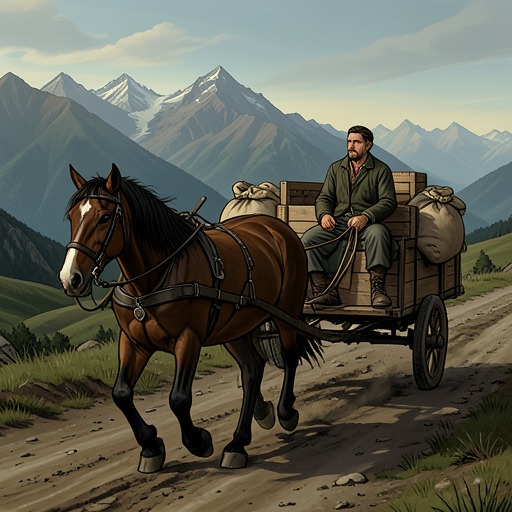
For the rest of the fall and part of the winter, Grainier leases the horses and wagon from the Pinkhams, boards the mares with their owners, and works as a freighter of sorts. Most of his jobs run east and west along Highway 2 among communities without convenient railway access. The arrangement grows directly out of the barn death and the practical afterlife of Hank's property: the wagon that carried the dead boy becomes the instrument through which Grainier finds work better suited to his declining body.
The change is also a release from the forest. Grainier had relished the physical intensity and scale of logging, serving as a choker among sawyers, limbers, buckers, horses, cable, and steam machinery. Yet the woods had already marked him. A wild limb once knocked his jaw crooked; his shoulder could lock until another person pulled it free; his knee began to wobble sideways. After the death of Hank and the resulting access to the wagon, Grainier can remain closer to home and enter a life organized around roads and neighboring communities rather than remote timber camps.
The event therefore belongs to a larger pattern in which labor continually exposes the body to forces beyond individual control. Logging injuries accumulate gradually, but Hank's death arrives as a single, incomprehensible interruption during a modest act of loading. Grainier's later freighting is not simply a career choice. It is a redirected survival strategy, born from a death that makes the limits of youth and strength suddenly undeniable.
Narrative Significance
Hank's death deepens Grainier's long confrontation with mortality. He later travels beside the Kootenai River while remembering William Coswell Haley, the dying boomer he failed to help, and the Chinese railroad hand he nearly helped kill. Those earlier memories make death a source of guilt and speculation; Hank's barn death gives it a new immediacy. Grainier is present, called upon to act, and still unable to prevent or explain what has happened.
The scene also exemplifies the episodic structure of Grainier's life. A minor errand—stopping for screws and helping with three sacks of cornmeal—opens into a death, a funeral transport, a new business, and a new social route through the region. The event does not resolve itself through heroic intervention. Its consequence comes through adaptation: Grainier stays, takes the wagon, and turns an encounter with death into a way of continuing.
In that sense, Hank Pinkham's sudden death is both an intimate family catastrophe and a hinge in Grainier's biography. It strips an everyday labor scene of its assumed safety, compels Grainier to look—however reluctantly—at death's physical reality, and sets him on the hauling life that allows him to remain near home after his years as a woodsman are ending.